


Looking for help with twin turbo set up. !!!!!!




from socal own purty mouth
https://my350z.com/forum/tuning/6053...l#post10625897
also in the same thread
also in the same thread
Last edited by travlee; Nov 30, 2015 at 05:33 PM.


Thread Starter
New Member
Joined: Aug 2015
Posts: 385
Likes: 3
From: south jersey
Thanks man. Kinda let this issue go for a while do to other things that popped up. Ok so since my power goal is 750 plus I guess I need to look into the 20g upgrade. If I upgrade to the 20 and leave the terbine like I was told from boost lab, is it true that I will be restricted with the exhaust side? Shouldn't I do the whole thing? Compressor and terbine upgrade?

New Member
Joined: Jan 2012
Posts: 530
Likes: 29
From: CT, RI, MA
When a turbo guy says he has 400 foot pounds it is across more than half of his RPM spectrum.
SC area under the curve is essentially the area of a triangle .5*B*H with B being RPMs and H being his peak torque. A turbo guy's area under the curve is the area of a rectangle L*W with L being RPM's and W being his peak TQ.

😂😂😂 I think I might of hit a nerve here. Don't be mad at me because you spent 20+ k on boosting your car and have endless problems with it while I spent under 7k and will smoke that aaaassssss! You probably couldn't even get traction on the street in 1st 2nd or 3rd basically useless for you 😂😂😂😂
Don't bother upgrading to 20g compressors. They are ancient tech and they're a horrible match to half of a 3.5L. They also surge like crazy above 18psi at sea level, 14psi at elevation.
There are billet 18g wheels that will outflow them available now. I've run the KTS 7 blade ET 20g wheel and it spools faster and outflows the standard 20g by about 25%. The smaller wheels perform about the same. It's not even worth bothering with the old cast wheels anymore now that billet wheels are available and cheap.
There are also superlight turbine wheels as well, and all of these parts drop directly into a standard MHI turbo cartridge and housings. MHI turbos (Greddy are all Mitsubishi Heavy Industries turbo cartridges) are component balanced (each part is balanced individually), so as long as the turbine hasn't touched the housings you can reassemble it in any orientation and it will retain balance. Those of us who have worked on MHI turbos have been rebuilding them this way for about a decade.
It's also worth upgrading the thrust bearing hardware with the larger bearing and double hole oiling plate. Kamak developed this kit about 7 years ago to deal with higher thrust loads from the billet wheels, and it's basically a copy of what Holset uses in their oiling system. It's a 360° bearing (all TD05/6 frame use a 360° bearing, FWIW) with two oiling holes and a larger diameter bearing surface. I've had turbos survive horrible on-throttle surge with this bearing with zero damage- surge that would have killed a standard MHI bearing (secondary intake butterflies got stuck closed causing the surge).
There are plenty of shops that can rebuild turbos (GpopShop, TurboLab, or any DSM shop can handle MHI turbos), or if you're even remotely mechanically inclined and have a decent snap ring pliers, you can do it yourself. It's really not difficult at all, just keep everything clean.
And make sure you're using a suitable oil feed for your turbos. The pressure sensor is unfiltered oil. MHI turbos are nearly indestructible if you feed them clean oil at the correct pressures.
There are billet 18g wheels that will outflow them available now. I've run the KTS 7 blade ET 20g wheel and it spools faster and outflows the standard 20g by about 25%. The smaller wheels perform about the same. It's not even worth bothering with the old cast wheels anymore now that billet wheels are available and cheap.
There are also superlight turbine wheels as well, and all of these parts drop directly into a standard MHI turbo cartridge and housings. MHI turbos (Greddy are all Mitsubishi Heavy Industries turbo cartridges) are component balanced (each part is balanced individually), so as long as the turbine hasn't touched the housings you can reassemble it in any orientation and it will retain balance. Those of us who have worked on MHI turbos have been rebuilding them this way for about a decade.
It's also worth upgrading the thrust bearing hardware with the larger bearing and double hole oiling plate. Kamak developed this kit about 7 years ago to deal with higher thrust loads from the billet wheels, and it's basically a copy of what Holset uses in their oiling system. It's a 360° bearing (all TD05/6 frame use a 360° bearing, FWIW) with two oiling holes and a larger diameter bearing surface. I've had turbos survive horrible on-throttle surge with this bearing with zero damage- surge that would have killed a standard MHI bearing (secondary intake butterflies got stuck closed causing the surge).
There are plenty of shops that can rebuild turbos (GpopShop, TurboLab, or any DSM shop can handle MHI turbos), or if you're even remotely mechanically inclined and have a decent snap ring pliers, you can do it yourself. It's really not difficult at all, just keep everything clean.
And make sure you're using a suitable oil feed for your turbos. The pressure sensor is unfiltered oil. MHI turbos are nearly indestructible if you feed them clean oil at the correct pressures.
So you Z guys have a oil pressure sensor, and the oil pressure switch like the G's have. Is the pressure switch filtered? That is where the greddy instructions have you tap in to feed the turbos... If that isn't filtered I need to address that somehow. Possibly tap into my cooler sandwich plate.

No the pressure switch is not filtered. Run a "forced performance" inline filter. I also run a pressure sensor AFTER the filter so I can monitor if the filter is getting clogged and see what pressure the turbos are seeing. Please note that there are two versions, one for journal bearing turbos and one for ball bearing (smaller .035" hole).
EDIT: Here it is... http://www.forcedperformance.net/PROD/FP4ANFilter.html
EDIT: Here it is... http://www.forcedperformance.net/PROD/FP4ANFilter.html
Last edited by rcdash; Mar 18, 2016 at 07:14 AM.
Thread Starter
New Member
Joined: Aug 2015
Posts: 385
Likes: 3
From: south jersey
No the pressure switch is not filtered. Run a "forced performance" inline filter. I also run a pressure sensor AFTER the filter so I can monitor if the filter is getting clogged and see what pressure the turbos are seeing. Please note that there are two versions, one for journal bearing turbos and one for ball bearing (smaller .035" hole).
EDIT: Here it is... http://www.forcedperformance.net/PROD/FP4ANFilter.html
EDIT: Here it is... http://www.forcedperformance.net/PROD/FP4ANFilter.html
New Member
Joined: Jan 2012
Posts: 530
Likes: 29
From: CT, RI, MA
No the pressure switch is not filtered. Run a "forced performance" inline filter. I also run a pressure sensor AFTER the filter so I can monitor if the filter is getting clogged and see what pressure the turbos are seeing. Please note that there are two versions, one for journal bearing turbos and one for ball bearing (smaller .035" hole).
EDIT: Here it is... http://www.forcedperformance.net/PROD/FP4ANFilter.html
EDIT: Here it is... http://www.forcedperformance.net/PROD/FP4ANFilter.html
The filter goes on the feed line to the turbos, of course. I have mine before the tee that splits to each turbo. The oil psi recommendations are different for journal vs ball bearing. 5-10 psi at idle, 30-40 psi max rpm for ball bearing turbos. I have the .035" restrictors on the turbos and the filter, which is also .03", running 4AN lines. I originally tried a filter with .05" orifice and I had a little leaking of oil around the center section until I went to a smaller size.
For journal bearing, I think 1/8" orifice is correct with no other restrictors. They need a lot of oil to cool the bearings.
I have been changing filters twice per year, but hardly see a few flecks so will probably change filter annually. The filter does catch these tiny black deposits.
EDIT: Here is the reference link for psi required for different turbos, http://www.turbomaster.info/eng/bulletins.php?id=31
For journal bearing, I think 1/8" orifice is correct with no other restrictors. They need a lot of oil to cool the bearings.
I have been changing filters twice per year, but hardly see a few flecks so will probably change filter annually. The filter does catch these tiny black deposits.
EDIT: Here is the reference link for psi required for different turbos, http://www.turbomaster.info/eng/bulletins.php?id=31
Last edited by rcdash; Mar 18, 2016 at 10:57 AM.
New Member
Joined: Jan 2012
Posts: 530
Likes: 29
From: CT, RI, MA
The filter goes on the feed line to the turbos, of course. I have mine before the tee that splits to each turbo. The oil psi recommendations are different for journal vs ball bearing. 5-10 psi at idle, 30-40 psi max rpm for ball bearing turbos. I have the .035" restrictors on the turbos and the filter, which is also .03", running 4AN lines. I originally tried a filter with .05" orifice and I had a little leaking of oil around the center section until I went to a smaller size.
For journal bearing, I think 1/8" orifice is correct with no other restrictors. They need a lot of oil to cool the bearings.
I have been changing filters twice per year, but hardly see a few flecks so will probably change filter annually. The filter does catch these tiny black deposits.
EDIT: Here is the reference link for psi required for different turbos, http://www.turbomaster.info/eng/bulletins.php?id=31
For journal bearing, I think 1/8" orifice is correct with no other restrictors. They need a lot of oil to cool the bearings.
I have been changing filters twice per year, but hardly see a few flecks so will probably change filter annually. The filter does catch these tiny black deposits.
EDIT: Here is the reference link for psi required for different turbos, http://www.turbomaster.info/eng/bulletins.php?id=31
Honestly my one problem is the fact that I don't know if my 18g's are ball or journal... Shame on me. I trusted the feed lines I ordered because the fittings had restrictions on them already. I am thinking I can't go wrong with the big orifice filter as long as the fittings still have restriction regardless of what type of bearing my turbos have. Any input?
Even if I had a pressure sensor after the filter I wouldn't know what pressure the bearings are seeing after the restriction fitting unfortunately.
Last edited by yosip1115; Mar 18, 2016 at 12:02 PM.
Thread Starter
New Member
Joined: Aug 2015
Posts: 385
Likes: 3
From: south jersey
I was under the impression that you just need like a 4an line for the feed. There is a certain siZe you need to go with? I'm planning like u said earlier to run an lines. Can anyone refer me to a site I can get all the fittings to change over and also what the correct lines I need?
Thread Starter
New Member
Joined: Aug 2015
Posts: 385
Likes: 3
From: south jersey
Honestly my one problem is the fact that I don't know if my 18g's are ball or journal... Shame on me. I trusted the feed lines I ordered because the fittings had restrictions on them already. I am thinking I can't go wrong with the big orifice filter as long as the fittings still have restriction regardless of what type of bearing my turbos have. Any input?
Even if I had a pressure sensor after the filter I wouldn't know what pressure the bearings are seeing after the restriction fitting unfortunately.
Even if I had a pressure sensor after the filter I wouldn't know what pressure the bearings are seeing after the restriction fitting unfortunately.
New Member
Joined: Jan 2012
Posts: 530
Likes: 29
From: CT, RI, MA
I was under the impression that you just need like a 4an line for the feed. There is a certain siZe you need to go with? I'm planning like u said earlier to run an lines. Can anyone refer me to a site I can get all the fittings to change over and also what the correct lines I need?
Thread Starter
New Member
Joined: Aug 2015
Posts: 385
Likes: 3
From: south jersey
Email stan@fast-turbo.com for their greddy 350z feed line kit. $85 for everything. Great quality too!!


take a deep look inside your CHRA, there is an small hole that feeds the bearings...you can use an AN -8 but that hole will only allow so much oil into the bearings. I run an AN4 off my post-filter port and then I 'Y' it to AN-3s before the turbos.
food for thought...
(that's a piece of teflon tape, not a metal shaving)
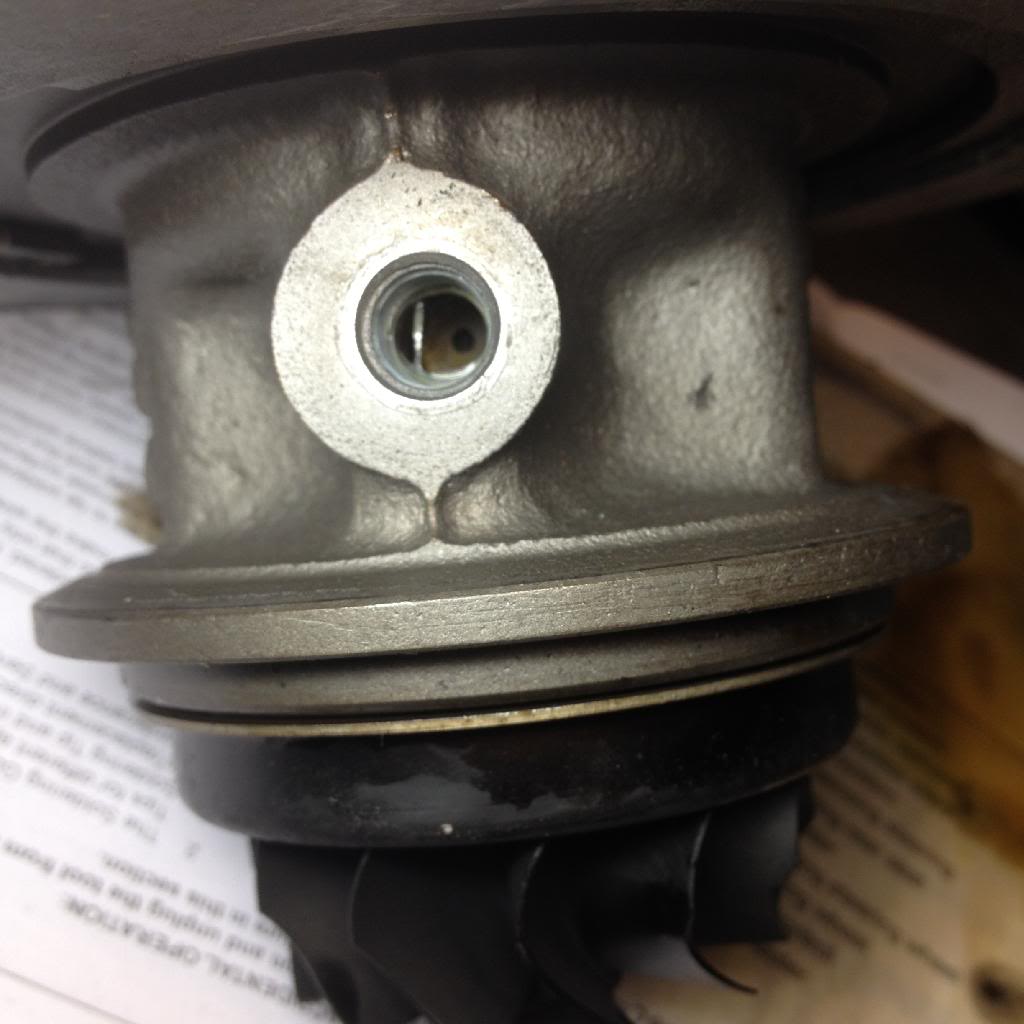
food for thought...
(that's a piece of teflon tape, not a metal shaving)


No the pressure switch is not filtered. Run a "forced performance" inline filter. I also run a pressure sensor AFTER the filter so I can monitor if the filter is getting clogged and see what pressure the turbos are seeing. Please note that there are two versions, one for journal bearing turbos and one for ball bearing (smaller .035" hole).
EDIT: Here it is... http://www.forcedperformance.net/PROD/FP4ANFilter.html
EDIT: Here it is... http://www.forcedperformance.net/PROD/FP4ANFilter.html
https://my350z.com/forum/forced-indu...l#post10733261
But i will be changing the push lock hose to series 200. It comes from oil pressure switch and then the -4AN going to tubro has NPT fitting with oil sensor (put in since photos) so i can monitor turbo getting oil. That way less chance of it getting blocked and can be changed every 2-3rd oil change.
Last edited by R6n350GT; Mar 22, 2016 at 04:31 AM.
Thread Starter
New Member
Joined: Aug 2015
Posts: 385
Likes: 3
From: south jersey
I did this myself
https://my350z.com/forum/forced-indu...l#post10733261
But i will be changing the push lock hose to series 200. It comes from oil pressure switch and then the -4AN going to tubro has NPT fitting with oil sensor (put in since photos) so i can monitor turbo getting oil. That way less chance of it getting blocked and can be changed every 2-3rd oil change.
https://my350z.com/forum/forced-indu...l#post10733261
But i will be changing the push lock hose to series 200. It comes from oil pressure switch and then the -4AN going to tubro has NPT fitting with oil sensor (put in since photos) so i can monitor turbo getting oil. That way less chance of it getting blocked and can be changed every 2-3rd oil change.